
Synergistic Metabolic Effects of Dapagliflozin Added to Pioglitazone in Type 2 Diabetes: a randomized comparative study
Dapagliflozin Added to Pioglitazone in Type 2 Diabetes
DOI:
https://doi.org/10.66381/jod.2026.001Keywords:
dapagliflozin, pioglitazone, dapagliflozin and pioglitazone, dapagliflozin and pioglitazone for diabetes, weight gainAbstract
Background:
Pioglitazone is an effective insulin sensitizer for type 2 diabetes mellitus (T2DM) but its use is limited by weight gain, edema, and heart failure risk. Sodium–glucose cotransporter-2 (SGLT2) inhibitors such as dapagliflozin improve glycemic control, promote weight loss, and reduce cardiovascular and renal adverse effects. Evidence evaluating the combined use of dapagliflozin with pioglitazone, particularly in real-world clinical settings, is lacking.
Objective:
To compare the efficacy and safety of dapagliflozin 10 mg added to pioglitazone-based conventional therapy versus pioglitazone with conventional therapy alone over 24 weeks in patients with T2DM.
Methods:
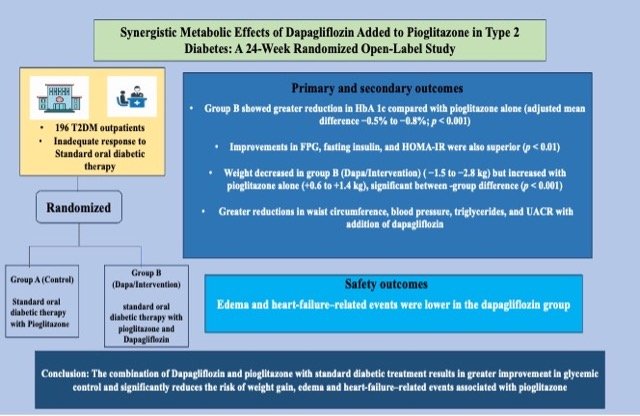
A 24-week, randomized, comparative study was conducted involving 196 adults with T2DM (98 per group). Participants were assigned to either (1) dapagliflozin 10 mg + pioglitazone + standard oral therapy, or (2) pioglitazone + standard therapy alone. The primary outcome was the change in HbA1c. Secondary outcomes included fasting plasma glucose (FPG), HOMA-IR, weight, BMI, waist circumference, blood pressure, lipid profile, eGFR, urinary albumin-to-creatinine ratio (UACR), and adverse events, including edema, macular edema, heart-failure–related events, and genital infections. Analyses included ANCOVA, paired t-tests, and logistic regression.
Results:
The dapagliflozin + pioglitazone group showed significantly greater reduction in HbA1c compared with pioglitazone alone (adjusted mean difference −0.5% to −0.8%; p < 0.001). Improvements in FPG, fasting insulin, and HOMA-IR were also superior (p < 0.01). Weight decreased in the dapagliflozin group (−1.5 to −2.8 kg) but increased with pioglitazone alone (+0.6 to +1.4 kg), producing a significant between-group difference (p < 0.001). Greater reductions occurred in waist circumference, blood pressure, triglycerides, and UACR with dapagliflozin. Edema and heart-failure–related events were significantly lower in the dapagliflozin group, with no cases of macular edema or hospitalization for heart failure. Safety outcomes were similar to known drug profiles.
Conclusion:
Many patients with type 2 diabetes are reluctant to initiate insulin therapy. Pioglitazone improves insulin sensitivity and glycemic control, but its use is constrained by weight gain and heart failure risk. The addition of dapagliflozin, through insulin-independent glucose-lowering and natriuretic effects, may mitigate these effects and provide a complementary treatment method. Adding dapagliflozin to pioglitazone-based therapy provides superior glycemic, metabolic, cardiovascular, and renal benefits compared with pioglitazone alone, while reducing fluid-retention related harmful effects. The combination represents a safe, effective, and clinically advantageous option for patients requiring intensified therapy for T2DM.
Keywords: Dapagliflozin, Pioglitazone, Type 2 diabetes, Weight gain, Edema, Heart failure, Dapagliflozin added to pioglitazone
Downloads
References
1. Damanik J, Yunir E. Type 2 Diabetes Mellitus and Cognitive Impairment. Acta Med Indones. 2021 Apr;53(2):213–20.
2. Javeed N, Matveyenko AV. Circadian Etiology of Type 2 Diabetes Mellitus. Physiology. 2018 Mar 1;33(2):138–50. https://doi.org/Y-00003-2018
3. Majety P, Lozada Orquera FA, Edem D, Hamdy O. Pharmacological approaches to the prevention of type 2 diabetes mellitus. Front Endocrinol. 2023 Mar 9;14:1118848. https://doi.org/10.3389/fendo.2023.1118848
4. Galicia-Garcia U, Benito-Vicente A, Jebari S, Larrea-Sebal A, Siddiqi H, Uribe KB, et al. Pathophysiology of Type 2 Diabetes Mellitus. IJMS. 2020 Aug 30;21(17):6275. https://doi.org/10.3390/ijms21176275
5. Valaiyapathi B, Gower B, Ashraf AP. Pathophysiology of Type 2 Diabetes in Children and Adolescents. CDR. 2020 Mar 20;16(3):220–9. https://doi.org/10.2174/1573399814666180608074510
6. Strati M, Moustaki M, Psaltopoulou T, Vryonidou A, Paschou SA. Early onset type 2 diabetes mellitus: an update. Endocrine. 2024 Mar 12;85(3):965–78. https://doi.org/10.1007/s12020-024-03772-w
7. Tegegne BA, Adugna A, Yenet A, Yihunie Belay W, Yibeltal Y, Dagne A, et al. A critical review on diabetes mellitus type 1 and type 2 management approaches: from lifestyle modification to current and novel targets and therapeutic agents. Front Endocrinol. 2024 Oct 18;15:1440456. https://doi.org/10.3389/fendo.2024.1440456
8. Ruze R, Liu T, Zou X, Song J, Chen Y, Xu R, et al. Obesity and type 2 diabetes mellitus: connections in epidemiology, pathogenesis, and treatments. Front Endocrinol. 2023 Apr 21;14:1161521. https://doi.org/10.3389/fendo.2024.1440456
9. Lian J, Fu J. Pioglitazone for NAFLD Patients With Prediabetes or Type 2 Diabetes Mellitus: A Meta-Analysis. Front Endocrinol. 2021 Apr 28;12:615409. https://doi.org/10.3389/fendo.2024.1440456
10. DeFronzo RA, Inzucchi S, Abdul-Ghani M, Nissen SE. Pioglitazone: The forgotten, cost-effective cardioprotective drug for type 2 diabetes. Diabetes and Vascular Disease Research. 2019 Mar;16(2):133–43. https://doi.org/10.1177/1479164118825
11. Liao H, Saver JL, Wu Y, et al. Pioglitazone and cardiovascular outcomes in patients with insulin resistance, pre-diabetes and type 2 diabetes: a systematic review and meta-analysis. BMJ Open 2017;7:e013927. doi: 10.1136/bmjopen-2016-013927
12. Schernthaner G, Currie CJ, Schernthaner GH. Do We Still Need Pioglitazone for the Treatment of Type 2 Diabetes? A risk-benefit critique in 2013. Diabetes Care. 2013 Aug 1;36(Supplement_2):S155–61. doi: 10.2337/dcS13-2031.
13. Balogh EG, Perez-Nieves M, Cao D, Hadjiyianni II, Ashraf N, Desai U, et al. Key Strategies for Overcoming Psychological Insulin Resistance in Adults with Type 2 Diabetes: The UK Subgroup in the EMOTION Study. Diabetes Ther. 2020 Aug;11(8):1735–44. https://doi.org/10.1007/s13300-020-00856-4.
14. DeFronzo RA. Insulin resistance, lipotoxicity, type 2 diabetes and atherosclerosis: the missing links. The Claude Bernard Lecture 2009. Diabetologia. 2010 Jul;53(7):1270–87. https://doi.org/10.1007/s00125-010-1684-1.
15. DeFronzo RA. From the Triumvirate to the Ominous Octet: A New Paradigm for the Treatment of Type 2 Diabetes Mellitus. Diabetes. 2009 Apr 1;58(4):773–95. doi: 10.1136/bmjopen-2016-013927.
16. Dhillon S. Dapagliflozin: A Review in Type 2 Diabetes. Drugs. 2019 Jul;79(10):1135–46. doi: 10.1007/s40265-019-01239-1.
17. Gautam K, Tripathy R, Meher D, et al. (April 27, 2023) Dapagliflozin Versus Vildagliptin as an Adjuvant to Metformin in Patients With Type 2 Diabetes Mellitus: A Randomized, Open-label Study. Cureus 15(4): e38200. doi:10.7759/cureus.38200.
18. Bajaj M, Baig R, Suraamornkul S, Hardies LJ, Coletta DK, Cline GW, et al. Effects of Pioglitazone on Intramyocellular Fat Metabolism in Patients with Type 2 Diabetes Mellitus. The Journal of Clinical Endocrinology & Metabolism. 2010 Apr 1;95(4):1916–23. doi: 10.1007/s40265-019-01239-1.
19. Lazzaroni E, Ben Nasr M, Loretelli C, Pastore I, Plebani L, Lunati ME, et al. Anti-diabetic drugs and weight loss in patients with type 2 diabetes. Pharmacological Research. 2021 Sep;171:105782. doi: 10.1007/s40265-019-01239-1.
20. Duan H, Chen F. Efficacy of dapagliflozin to treat nonalcoholic fatty liver disease in patients with type 2 diabetes: A meta-analysis. Medicine. 2025 Jan 3;104(1):e40836. DOI: 10.1097/MD.0000000000040836.
21. Cusi K, Orsak B, Bril F, Lomonaco R, Hecht J, Ortiz-Lopez C, et al. Long-Term Pioglitazone Treatment for Patients With Nonalcoholic Steatohepatitis and Prediabetes or Type 2 Diabetes Mellitus: A Randomized Trial. Ann Intern Med. 2016 Sep 6;165(5):305–15. DOI: 10.1097/MD.0000000000040836
22. Katsimardou A, Theofilis P, Vordoni A, Doumas M, Kalaitzidis RG. The Effects of SGLT2 Inhibitors on Blood Pressure and Other Cardiometabolic Risk Factors. IJMS. 2024 Nov 18;25(22):12384. https://doi.org/10.3390/ijms252212384
23. Tangri N, Rastogi A, Nekeman-Nan C, Hong LS, Ozaki A, Franzén S, et al. Dapagliflozin Utilization in Chronic Kidney Disease and Its Real-World Effectiveness Among Patients with Lower Levels of Albuminuria in the USA and Japan. Adv Ther. 2024 Mar;41(3):1151–67. https://doi.org/10.3390/ijms252212384
24. Shah BR, Phatak S, Phatak P, Shah HB, Phatak I, Shah DB. Sodium-glucose cotransporter-2 (SGLT-2) inhibitors and genital infections in patients with diabetic mellitus and concomitant coronary artery disease: a single-center experience. Cureus. 2022 Nov 23;14(11):e31842. DOI: 10.7759/cureus.31842
25. Puckrin, R., Saltiel, MP., Reynier, P. et al. SGLT-2 inhibitors and the risk of infections: a systematic review and meta-analysis of randomized controlled trials. Acta Diabetol 55, 503–514 (2018). https://doi.org/10.1007/s00592-018-1116-0
26. Verma, S., McMurray, J.J.V. SGLT2 inhibitors and mechanisms of cardiovascular benefit: a state-of-the-art review. Diabetologia 61, 2108–2117 (2018). https://doi.org/10.1007/s00125-018-4670-7
27. Nesto RW, Bell D, Bonow RO, Fonseca V, Grundy SM, Horton ES, et al. Thiazolidinedione Use, Fluid Retention, and Congestive Heart Failure: A Consensus Statement From the American Heart Association and American Diabetes Association. Circulation. 2003 Dec 9;108(23):2941–8. https://doi.org/10.1161/01.CIR.0000103683.99399.7
28. Core JQ, Hua P, Daniel E, Grunwald JE, Jaffe G, Maguire MG, et al. Thiazolidinedione use and retinal fluid in the comparison of age-related macular degeneration treatments trials. Br J Ophthalmol. 2023 Jul;107(7):1000–6.
29. Patel K, Nair A. A literature review of the therapeutic perspectives of sodium-glucose cotransporter-2 (SGLT2) inhibitor-induced euglycemic diabetic ketoacidosis. Cureus. 2022 Sep 27;14(9). DOI: 10.7759/cureus.29652
30. Sharma PV, Jobanputra YB, Lewin K, Bagatell S, Lichtstein DM. Diabetic Ketoacidosis in Patients with Type 2 Diabetes on Sodium-Glucose Cotransporter-2 Inhibitors - A Case Series. RRCT. 2018 May 7;13(2):156–60. https://doi.org/10.2174/1574887113666180314101436
31. Pavlova V, Filipova E, Uzunova K, Kalinov K, Vekov T. Pioglitazone Therapy and Fractures: Systematic Review and Meta- Analysis. EMIDDT. 2021 Sep;18(5):502–7. DOI: https://doi.org/10.2174/1871530318666180423121833
Published
Data Availability Statement
The data supporting the findings of this study are available from the corresponding author upon reasonable request, in accordance with the data sharing policies of the Journal of Diabesity. All data sharing will comply with ethical standards and participant confidentiality requirements.
License
Copyright (c) 2026 Journal of Diabesity

This work is licensed under a Creative Commons Attribution 4.0 International License.
All articles published in the Journal of Diabesity (JOD) are licensed under the Creative Commons Attribution 4.0 International License (CC BY 4.0).
What this means:
Under the CC BY 4.0 license, authors retain copyright of their work, while allowing others to:
-
Share — Copy and redistribute the material in any medium or format
-
Adapt — Remix, transform, and build upon the material for any purpose, even commercially
Conditions:
Users must provide appropriate attribution to the original author(s) and source, including:
-
The article title
-
Author(s) name(s)
-
Journal name (Journal of Diabesity)
-
DOI or link to the original article
-
An indication if changes were made
There is no restriction on commercial use or derivative works, as long as proper attribution is given.
Full License Text:
https://creativecommons.org/licenses/by/4.0/
✍️ Author Rights:
-
Authors retain copyright and grant JOD the right of first publication.
-
Authors may archive the published version in institutional repositories, personal websites, or other platforms with proper citation.