
Patient-Reported Changes in Weight, Appetite, and Lifestyle During Evolocumab Therapy
DOI:
https://doi.org/10.66381/jod.2026.006Keywords:
Evolocumab, PCSK9 inhibitors, weight loss, dyslipidemia, weight gainAbstract
Abstract
Background
Evolocumab is a PCSK9 inhibitor that has demonstrated efficacy in lowering LDL-C levels and in reducing cardiovascular event risk. Even though initial clinical trials have not consistently reported weight change as an adverse effect, anecdotal patient reports show potential changes in body weight associated with its use.
Objective
To assess patient-reported changes in body weight, appetite, and lifestyle behaviors after initiation of evolocumab using an anonymous online questionnaire.
Methods
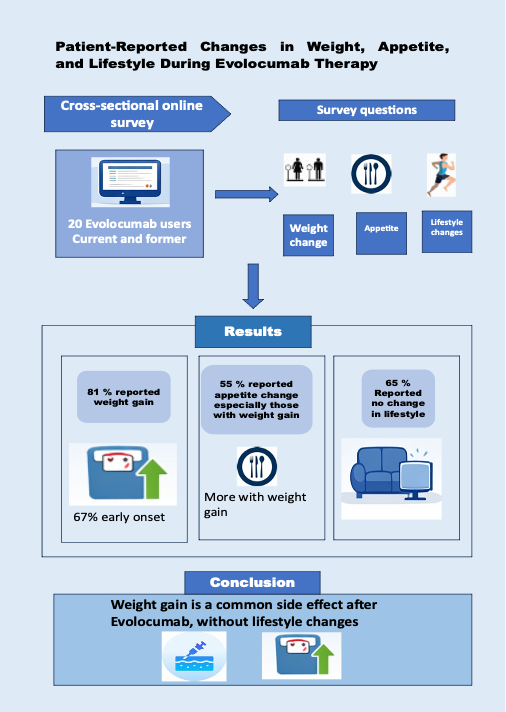
It was a cross-sectional, online survey carried out among self-identified current or former users of evolocumab. Participants completed a survey questionnaire regarding weight changes and their timing, appetite, lifestyle modifications, and subjective effects of the drug. Their responses were summarized by using descriptive statistical methods; 95% confidence intervals (CIs) were measured for each proportion, and Fisher’s exact test was later applied for comparing subgroups.
Results:
After initiating evolocumab, 19 (90%; 95% CI 68–99%) out of 20 respondents conveyed weight changes. Seventeen participants (81%; 95% CI 59–95%) reported weight gain, while 4 (19%; 95% CI 5–41%) experienced weight loss. Weight changes were observed within the first few weeks by 14 individuals (67%; 95% CI 43–85%). Regarding lifestyle behavior, most participants (13/20; 65%) did not perceive any change. Sixteen respondents (84%) noticed a significant impact of evolocumab on their weight, with perceived impact more frequent among those reporting weight gain (88% vs 25%, p = 0.02). 11 respondents (55%) conveyed appetite changes, especially those who disclosed weight gain (59% vs 25%, p = 0.3).
Conclusions:
An exploratory online survey indicated weight gain after initiating evolocumab, usually early during therapy, and was independent of lifestyle changes. These results highlight the relevance of patient-perceived drug effects on quality of life. This survey supports conducting the prospective studies to evaluate weight-related effects of PCSK9 inhibitors.
Downloads
References
1. Huang JX, Yousaf A, Moon J, Ahmed R, Uppal K, Pemminati S, Julie M, Ramiz AK. Recent advances in the management of dyslipidemia: A systematic review. Cureus. 2025 Mar 23;17(3). DOI: 10.7759/cureus.81034
2. Ballena-Caicedo J, Zuzunaga-Montoya FE, Loayza-Castro JA, Vásquez-Romero LEM, Tapia-Limonchi R, De Carrillo CIG, et al. Global prevalence of dyslipidemias in the general adult population: a systematic review and meta-analysis. J Health Popul Nutr [Internet]. 2025 Aug 26; 44(1):308. DOI: 10.1186/s41043-025-01054-3
3. Silverman MG, Ference BA, Im K, Wiviott SD, Giugliano RP, Grundy SM, et al. Association Between Lowering LDL-C and Cardiovascular Risk Reduction Among Different Therapeutic Interventions: A Systematic Review and Meta-analysis. JAMA [Internet]. 2016 Sep 27;316(12):1289. DOI: 10.1001/jama.2016.13985
4. Suh SH, Kim SW. Dyslipidemia in Patients with Chronic Kidney Disease: An Updated Overview. Diabetes Metab J [Internet]. 2023 Sep 30;47(5):612–29. DOI: 10.4093/dmj.2023.0067
5. Visconti L, Benvenga S, Lacquaniti A, Cernaro V, Bruzzese A, Conti G, et al. Lipid disorders in patients with renal failure: Role in cardiovascular events and progression of chronic kidney disease. Journal of Clinical & Translational Endocrinology [Internet]. 2016 Dec; 6:8–14. DOI: 10.1016/j.jcte.2016.08.002
6. Laakso M, Fernandes Silva L. Statins and risk of type 2 diabetes: mechanism and clinical implications. Front Endocrinol [Internet]. 2023 Sep 19; 14:1239335. DOI: 10.3389/fendo.2023.1239335
7. Stein EA, Raal FJ. New Therapies for Reducing Low-Density Lipoprotein Cholesterol. Endocrinology and Metabolism Clinics of North America [Internet]. 2014 Dec; 43(4):1007–33. DOI: 10.1016/j.ecl.2014.08.008
8. Baloch AA, Shabir KU, Kiran Z, Fatima N, Hasan SM. Safety and efficacy of dapagliflozin in patients with type 2 diabetes mellitus during fasting in the month of Ramadan: an experience from tertiary care hospital. Int J Diabetes Dev Ctries [Internet]. 2024 Jul 29. DOI: 10.1007/s13410-024-01380-y
9. Kasichayanula S, Grover A, Emery MG, Gibbs MA, Somaratne R, Wasserman SM, et al. Clinical Pharmacokinetics and Pharmacodynamics of Evolocumab, a PCSK9 Inhibitor. Clin Pharmacokinet [Internet]. 2018 Jul; 57(7):769–79. DOI: 10.1007/s40262-017-0620-7
10. Evolocumab. In: LiverTox: Clinical and Research Information on Drug-Induced Liver Injury [Internet]. Bethesda (MD): National Institute of Diabetes and Digestive and Kidney Diseases; 2012. Available from: http://www.ncbi.nlm.nih.gov/books/NBK548469/
11. Santos RD, Stein EA, Hovingh GK, Blom DJ, Soran H, Watts GF, et al. Long-Term Evolocumab in Patients With Familial Hypercholesterolemia. Journal of the American College of Cardiology [Internet]. 2020 Feb; 75(6):565–74. DOI: 10.1016/j.jacc.2019.12.020
12. Liu C, Lu H, Yuan F, Chen WL, Xu HR, Li H, Hsu CP, Egbuna O, Wu J, Dias C, Abosaleem B, Rana J, Monsalvo ML, Li XN, Yu Z. A Phase 1, Randomized, Double-Blind, Single-Dose, Placebo-Controlled Safety, Tolerability, And Pharmacokinetic/Pharmacodynamic Study Of Evolocumab In Healthy Chinese Subjects. Clin Pharmacol. 2019;11:145-153. DOI: 10.2147/CPAA.S208033
13. Berberich AJ, Hegele RA. A Modern Approach to Dyslipidemia. Endocrine Reviews [Internet]. 2022 Jul 13; 43(4):611–53. DOI: 10.1210/endrev/bnab037
14. Zhang S, Sun T, Song L, Jin X, Li B. Efficacy and safety of statins, ezetimibe, and fibrates monotherapy or combination therapy for hyperlipidemia: a systematic review and network meta-analysis. Eur J Med Res [Internet]. 2025 Jun 23; 30(1):509. DOI: 10.1186/s40001-025-02805-y
15. Ridker PM, Mora S, Rose L. Percent reduction in LDL cholesterol following high-intensity statin therapy: potential implications for guidelines and for the prescription of emerging lipid-lowering agents. Eur Heart J [Internet]. 2016 May 1; 37(17):1373–9. DOI: 10.1093/eurheartj/ehw046
16. Katzmann JL, Stürzebecher PE, Kruppert S, Laufs U. LDL cholesterol target attainment in cardiovascular high- and very-high-risk patients with statin intolerance: a simulation study. Sci Rep [Internet]. 2024 Jan 4;14(1):474. DOI: 10.1038/s41598-023-50847-1
17. Morieri ML, Perrone V, Veronesi C, Degli Esposti L, Andretta M, Plebani M, et al. Improving statin treatment strategies to reduce LDL-cholesterol: factors associated with targets’ attainment in subjects with and without type 2 diabetes. Cardiovasc Diabetol [Internet]. 2021 Dec; 20(1):144. DOI: 10.1186/s12933-021-01338-y
18. Tokgözoğlu L, Libby P. The dawn of a new era of targeted lipid-lowering therapies. European Heart Journal [Internet]. 2022 Sep 7;43(34):3198–208. DOI: 10.1093/eurheartj/ehab841
19. Sabatine MS, Giugliano RP, Keech AC, Honarpour N, Wiviott SD, Murphy SA, et al. Evolocumab and Clinical Outcomes in Patients with Cardiovascular Disease. N Engl J Med [Internet]. 2017 May 4;376(18):1713–22. DOI: 10.1056/NEJMoa1615664
20. Sabatine MS, Giugliano RP, Wiviott SD, Raal FJ, Blom DJ, Robinson J, et al. Efficacy and Safety of Evolocumab in Reducing Lipids and Cardiovascular Events. N Engl J Med [Internet]. 2015 Apr 16;372(16):1500–9. DOI: 10.1056/NEJMoa1500858
21. Lloyd-Jones DM, Morris PB, Ballantyne CM, Birtcher KK, Covington AM, DePalma SM, et al. 2022 ACC Expert Consensus Decision Pathway on the Role of Nonstatin Therapies for LDL-Cholesterol Lowering in the Management of Atherosclerotic Cardiovascular Disease Risk: A Report of the American College of Cardiology Solution Set Oversight Committee. JACC. 2022 Oct, 80 (14) 1366–1418. DOI: 10.1016/j.jacc.2022.07.006
22. Ji C, Bai J, Zhou J, Zou Y, Yu M. Adverse event profiles of PCSK9 inhibitors alirocumab and evolocumab: Data mining of the FDA adverse event reporting system. Brit J Clinical Pharma [Internet]. 2022 Dec; 88(12):5317–25. DOI: 10.1111/bcp.15460
Published
Data Availability Statement
All data generated or analyzed during this case report are included in this published article. No additional datasets were generated or analyzed.
License
Copyright (c) 2025 Journal of Diabesity

This work is licensed under a Creative Commons Attribution 4.0 International License.
All articles published in the Journal of Diabesity (JOD) are licensed under the Creative Commons Attribution 4.0 International License (CC BY 4.0).
What this means:
Under the CC BY 4.0 license, authors retain copyright of their work, while allowing others to:
-
Share — Copy and redistribute the material in any medium or format
-
Adapt — Remix, transform, and build upon the material for any purpose, even commercially
Conditions:
Users must provide appropriate attribution to the original author(s) and source, including:
-
The article title
-
Author(s) name(s)
-
Journal name (Journal of Diabesity)
-
DOI or link to the original article
-
An indication if changes were made
There is no restriction on commercial use or derivative works, as long as proper attribution is given.
Full License Text:
https://creativecommons.org/licenses/by/4.0/
✍️ Author Rights:
-
Authors retain copyright and grant JOD the right of first publication.
-
Authors may archive the published version in institutional repositories, personal websites, or other platforms with proper citation.